What your child will discover
Help the child understand the solar system as the Sun and the many objects gravitationally connected to it, including planets, dwarf planets, moons, small bodies, dust, gas, plasma, and human-made spacecraft.
Lesson 285 of 300
Explore the Sun and the gravitationally connected planets, dwarf planets, moons, rings, asteroids, comets, dust, plasma, and distant reservoirs surrounding it.
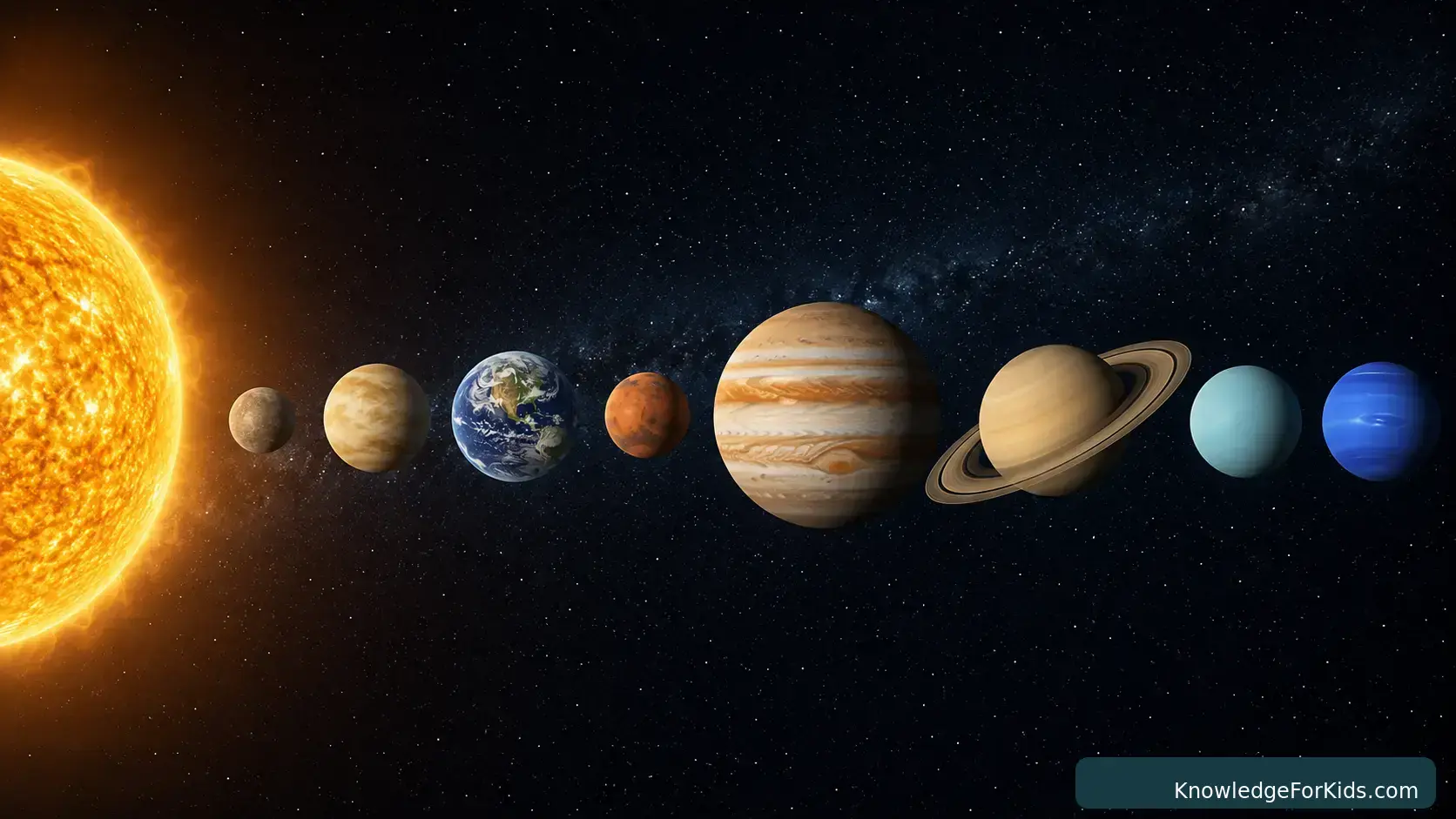 Original educational image · KnowledgeForKids.com
Help the child understand the solar system as the Sun and the many objects gravitationally connected to it, including planets, dwarf planets, moons, small bodies, dust, gas, plasma, and human-made spacecraft.
"The solar system includes the Sun and the many objects connected to it by gravity. Eight planets orbit the Sun: Mercury, Venus, Earth, Mars, Jupiter, Saturn, Uranus, and Neptune. The system also contains dwarf planets, hundreds of moons, rings, asteroids, comets, dust, gas, plasma, and spacecraft. The rocky planets are closer to the Sun. Farther out are two gas giants and two ice giants. Beyond Neptune lies the Kuiper Belt and more distant populations of icy objects. The Sun's solar wind creates a vast region called the heliosphere. The solar system formed about four-point-six billion years ago from gas and dust. The solar system is a vast moving family of objects held together mainly by the Sun's gravity." DESIGN REQUIREMENTS: Provide separate size and distance modes. Every compressed diagram must say visually that it is not to scale. Avoid crowded asteroid fields, identical planet spacing, decorative orbit rails, or a hard visible Oort Cloud shell.
Pause, point, name what you notice, and connect the idea to something familiar in your child's day. Repetition, a calm voice, shared attention and dependable care matter more than finishing quickly.